
Sweepstakes Playthrough Requirements: How Multipliers Affect Your SC
 Available in US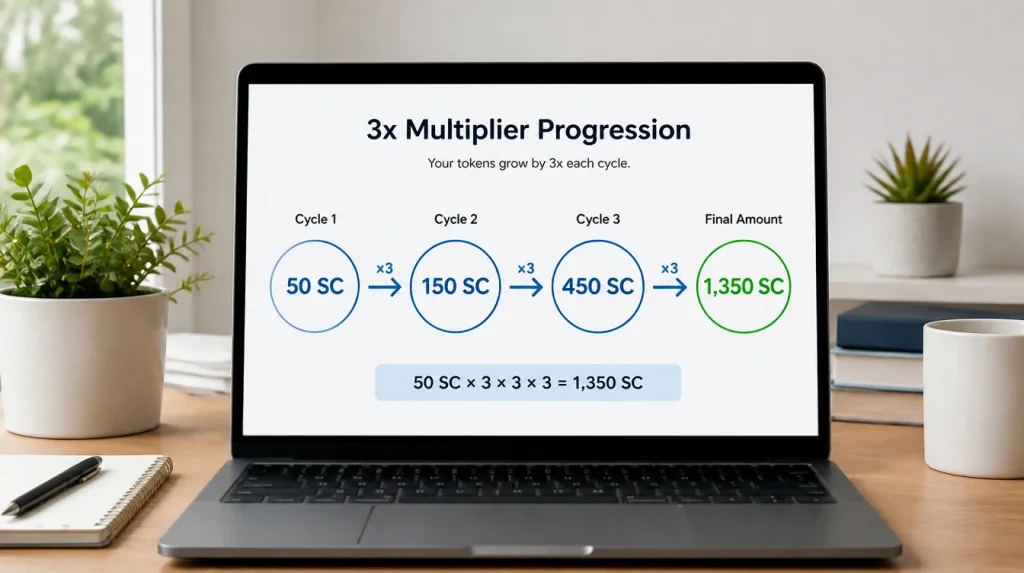
I once received 50 bonus Sweeps Coins with a Gold Coin purchase and assumed I could redeem them after a few spins. Three hours later, I had wagered over 150 SC — the 50 SC bonus multiplied by a 3x playthrough requirement — and my balance sat at 22 SC. The math had worked exactly as designed: every wagering cycle exposed my balance to the house edge, and by the time I cleared the playthrough, most of the bonus was gone. That experience taught me what too many players learn the hard way: the headline bonus number is not what you get to keep. The playthrough requirement is the real price tag.
Playthrough requirements — also called wagering requirements or rollover conditions — determine how many times you must wager your bonus Sweeps Coins before they become eligible for redemption. In an industry generating $3.6 to $4.2 billion in net gaming revenue in 2025, these requirements are the primary mechanism operators use to control the flow of promotional SC from bonus to cashout. Understanding them is the difference between evaluating a bonus accurately and falling for a number that exists only on a marketing page.
What Playthrough Requirements Are and How They Work
The first time I explained playthrough to a friend, I used a grocery store analogy that stuck. Imagine a store gives you a $50 gift card, but you have to spend $150 total at the store before you can use it. Every time you shop, you buy things you do not get to return. By the time you reach $150 in total spending, you have already consumed most of the value through groceries you ate along the way. That is playthrough in a nutshell.
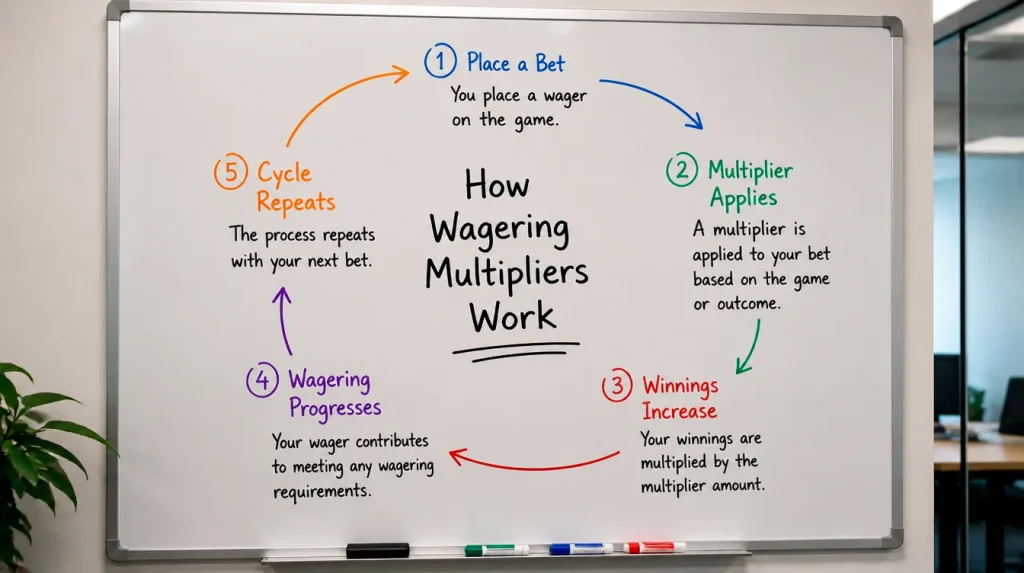
A 1x playthrough means you must wager the bonus SC amount once before it becomes redeemable. If you receive 20 SC with a 1x requirement, you wager 20 SC total. At a 96% RTP, the expected return after one cycle is 19.2 SC — you lose about 4% to the house edge. A 1x playthrough is the lightest possible condition and the closest to “free money” that sweepstakes casinos offer.
A 3x playthrough on that same 20 SC means you must wager 60 SC total. You do not need 60 SC in your account — you wager the same coins repeatedly, with each cycle eroding your balance. After three cycles at 96% RTP, the expected outcome is roughly 20 x 0.96 x 0.96 x 0.96 = 17.7 SC. The house edge compounds with each cycle, and the difference between 1x and 3x translates to approximately 1.5 SC in expected value lost — a 7.5% reduction on the original bonus.
At 5x playthrough, that same 20 SC bonus requires 100 SC in total wagers. The expected balance after five wagering cycles drops to approximately 16.3 SC. At 10x, it falls to around 13.3 SC. The pattern is exponential decay: each additional multiplier costs more in expected value than the last, and at high enough multipliers, the bonus becomes mathematically worthless — the expected balance after clearing playthrough approaches zero.
Playthrough by Operator: Who Demands the Most
I tracked playthrough conditions across every platform I tested during my 16-week payout evaluation cycle. The spread is wider than most players expect.
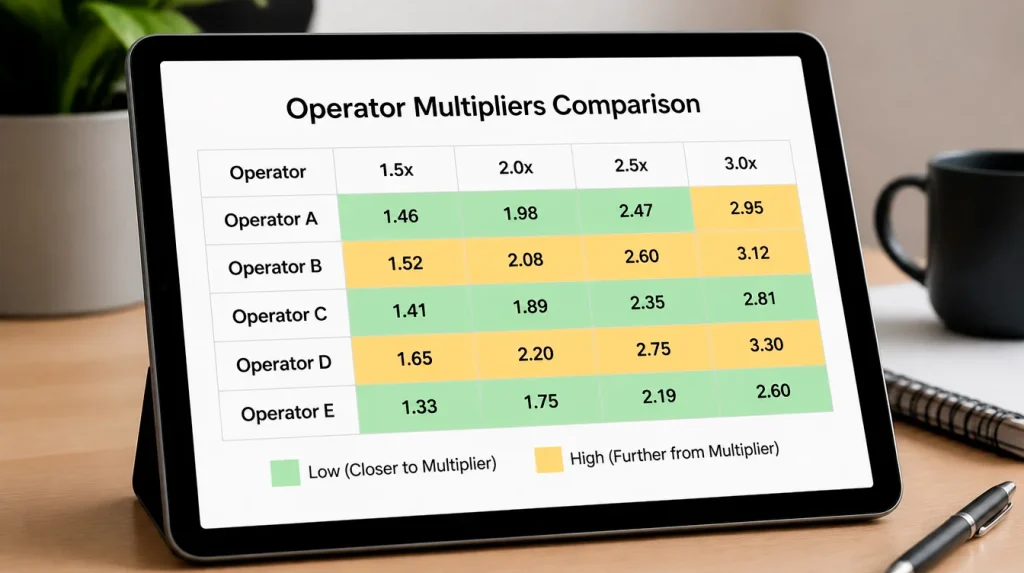
The most player-friendly operators attach no playthrough to bonus SC at all. Zero playthrough means the SC credited with your Gold Coin purchase is immediately eligible for redemption — wager it once, win enough to clear the minimum threshold, and you can cash out. These operators are betting that the entertainment value keeps you playing voluntarily rather than forcing you to play through arbitrary multipliers. It is a confidence move that signals the platform expects to retain players through game quality rather than bonus traps.
The middle tier runs 1x to 3x playthrough. At 1x, the impact on your expected value is minimal — a 4% haircut at 96% RTP. At 3x, you are giving back about 12% of the bonus value to the house edge before you can touch the remainder. Most players can clear 1x to 3x playthrough in a single session without extraordinary outcomes, which makes these requirements annoying but manageable.
The aggressive tier starts at 5x and extends to 10x or higher at some platforms. These multipliers transform a seemingly generous bonus into a retention device. A 100 SC bonus with a 10x playthrough requires 1,000 SC in total wagers — the expected value after clearing at 96% RTP is roughly 66 SC, and most players will see their balance fluctuate to zero before reaching the target. Operators at this tier are not offering bonuses; they are offering the illusion of bonuses while structurally ensuring most players never redeem them.
About 60% of sweepstakes casino users are casual, low-engagement players. For that demographic, a high playthrough requirement effectively nullifies the bonus because casual players do not wager enough volume to clear it within their typical session patterns. The bonus expires unused, or the balance erodes to nothing before the requirement is met.
Calculating the Real Value of Any Bonus
After years of evaluating bonuses, I developed a simple formula that cuts through marketing noise and tells you what a bonus is actually worth in expected redemption value.
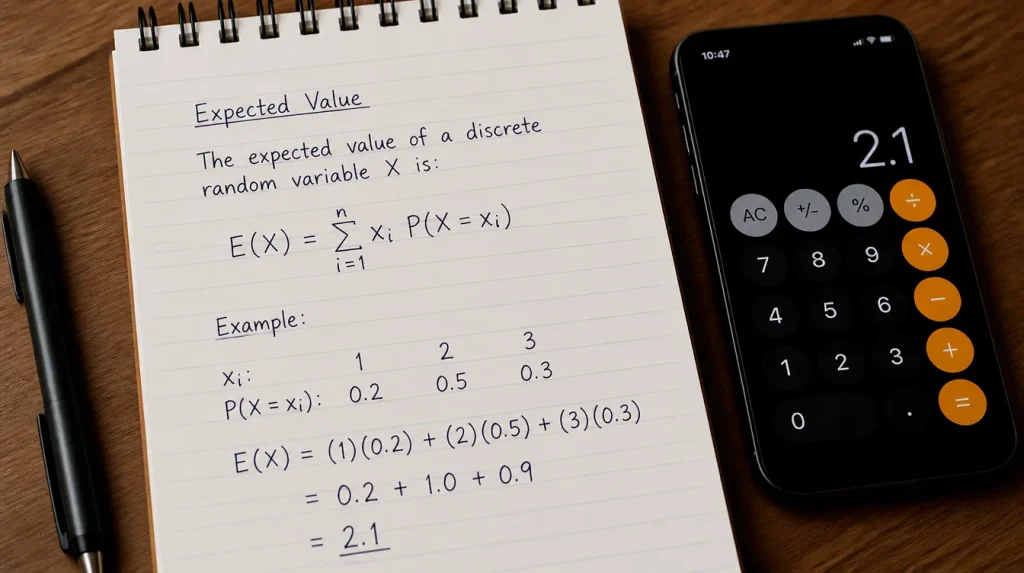

Take the bonus SC amount. Multiply it by (RTP percentage) raised to the power of the playthrough multiplier. The result is your expected SC balance after clearing the requirement. For a 30 SC bonus with 3x playthrough at 96% RTP: 30 x (0.96)^3 = 30 x 0.885 = 26.5 SC expected value. For the same bonus at 5x: 30 x (0.96)^5 = 30 x 0.815 = 24.5 SC. The formula assumes you wager the full bonus amount each cycle, which is a simplification — in practice, you wager smaller amounts per spin, and variance introduces both upside and downside around the expected value.
The formula also assumes you know the RTP of the games you are playing. At platforms that publish game-level RTP data, this calculation is straightforward. At platforms that do not disclose RTP, you are guessing at a variable that directly determines how much of your bonus survives the playthrough gauntlet. Playing games with undisclosed RTPs under high playthrough requirements is a double uncertainty that compounds risk.
Two bonuses that look different on a marketing page can have identical expected values. A 20 SC bonus with 1x playthrough (expected value: 19.2 SC) is worth more than a 25 SC bonus with 3x playthrough (expected value: 22.1 SC), but both are worth substantially more than a 50 SC bonus with 10x playthrough (expected value: 33.2 SC). The player who chases the biggest headline number without checking the multiplier consistently gets less value than the player who does the math. For a broader perspective on how these multipliers interact with no deposit bonus mechanics, the calculation framework applies identically to registration SC.
Game Contributions and Other Hidden Conditions
Playthrough multipliers are the headline condition, but they are not the only one. Several operators apply differential game contribution rates — meaning not all games count equally toward clearing the playthrough requirement.


Slots typically contribute 100% — every SC wagered on a slot counts fully toward the playthrough total. Table games often contribute less: 10% to 50% is common for blackjack and roulette, meaning a 1 SC blackjack wager might count as only 0.10 SC toward the requirement. Live dealer games may contribute even less or be excluded entirely. If you prefer table games and your bonus carries a playthrough requirement with reduced table game contributions, clearing the requirement becomes dramatically more expensive because you must wager 5x to 10x more total SC to reach the same playthrough target.
Time limits add another layer. Some operators require you to clear the playthrough within 7, 14, or 30 days of receiving the bonus. Fail to complete it within the window, and the bonus SC and any winnings derived from it are forfeited. For casual players who log in a few times per week, a 7-day window combined with a high multiplier can make the bonus physically impossible to clear given their typical session frequency and duration.
Maximum bet limits during playthrough restrict the amount you can wager per spin while clearing the requirement. A typical limit might cap SC wagers at 5 SC per spin during the playthrough phase. This prevents players from clearing the requirement in a few high-variance spins but also extends the session time needed to complete it, which increases the total exposure to the house edge.
The interplay of these conditions — multiplier, game contributions, time limits, and bet caps — creates the true playthrough burden. Evaluating a bonus on the multiplier alone misses at least half the picture. Reading the full terms before accepting a bonus is not optional; it is the minimum due diligence for protecting the value of your SC balance.
What is a good playthrough requirement at a sweepstakes casino?
A 1x playthrough is the most player-friendly standard, costing approximately 4% of the bonus value at a 96% RTP game. Zero playthrough — where bonus SC is immediately redeemable — is ideal but less common. Requirements of 3x or below are generally reasonable. Anything above 5x significantly erodes the real value of the bonus, and requirements of 10x or higher make most bonuses mathematically unprofitable for the average player.
Do all sweepstakes casino games count equally toward playthrough?
No. Most operators apply differential game contribution rates. Slots typically contribute 100% toward clearing the playthrough requirement, while table games like blackjack and roulette may contribute only 10% to 50%. Some operators exclude live dealer games entirely. These contribution rates mean that a player clearing playthrough exclusively through table games must wager significantly more total SC than a player using slots. Check the specific game contribution schedule in the bonus terms before choosing which games to play during the playthrough period.
The full ranking is in our guide to the best US sweepstakes casinos.
The offers the playthrough applies to: the welcome bonuses.
Articles
Created by the "Best Sweepstakes Casinos US" editorial team.